
Discouraged how Canada is perceived in the news?
Faith in Canada: A story that will remind you of who we are

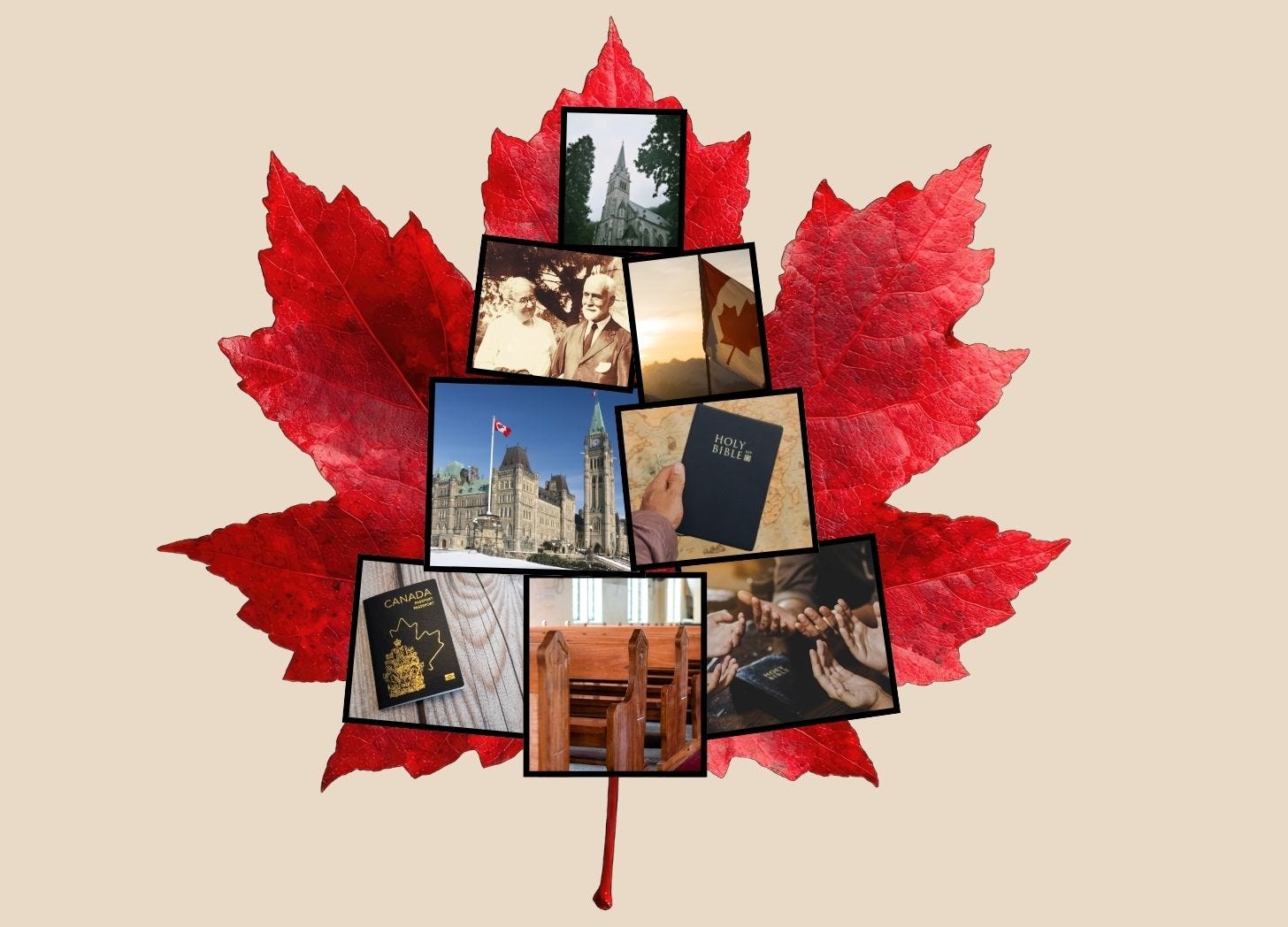
If you spend any of your time on social media (your first mistake), like me, you may have noticed a lot of negativity and shade being thrown at Canada.
Whoever we are and whatever we may be—as individuals or as a collective—it seems clear that the Canadian brand has more than just a PR problem.
Here’s but one example of sentiment seeping onto social feeds, by the media personality Matt Walsh. Many readers, especially Canadian readers, may immediately dismiss him because they don’t like his politics (he’s a MAGA conservative), his style (bare knuckle and blunt commentary), or his platform (he contributes to the Daily Wire). Here’s a recent post from him that went viral:

Ouch.
This may be a strong view, but it’s decreasingly niche.
In all the trash talking and good-natured ribbing that came from the Olympics (from memes of the “cheating curlers” to all the banter after our heartbreaking losses in both Women’s and Men’s hockey) this type of posting emerged too, as politics, online cultural dispositions, and Canadian policies came to the fore.
I’m not here to defend against or affirm what others are saying, to point out what criticism is valid, what’s good fun, and what’s unfair. As I look at how outsiders perceive the nation where I am from, I admit alarm.
The news I hear about the status quo in Canada is troubling to me too. You’ve read my concerns about MAiD, which only increase. I’m alarmed at the desecration and destruction of churches. I’m troubled by many other issues we face in Canada (line ups at food banks, healthcare access, and how we value life are just a few).
But these aren’t the only stories.
We have a lot going wrong. But there’s so much goodness, too. In a time of downturn (economically, spiritually, socially) I wanted to take a break from the bad news and foreground a truth:
Every day there is goodness in my community, at our school, in our church, and on our street.
I want to take some time here on Things I Wrote Down to focus on Faith in Canada, past and present. Maybe it will be a single post; maybe I’ll string together a series.
Wherever this goes, it feels subversive and exciting to swim against the sea of negativity and reflect and highlight some good news.

A Go-to story of faith
Travel back in time with me to a warm afternoon in May of 1885. The leaves on the maple trees are green and growing. A young woman has just graduated from the Toronto School of Art. Her entire life is ahead of her.
Rosalind Bell-Smith’s body was in Ontario, but her heart was in London, England at the art school where she would finish her studies and begin her career as an artist. But on the day she was supposed to leave Canada to study art in Europe, Rosalind chose to delay her trip to help serve at a Sunday service, playing the organ at a Sunday Bible meeting.
She had been on a boat with a group of artist friends travelling to a picnic at Niagara Falls just one week before. On the same boat was another group, headed to the Niagara-on-the-Lake Bible Conference. After a day of picnicking, wishing she had gone to the Bible Conference, the Bible class teacher, Henry O’Brien, bumped into Rosalind. She had played the organ for him at a recent meeting in Toronto. He was excited to see her and asked her to come to the conference the next week to play music, on the very day she was supposed to travel to England.
As Mr. O'Brien turned to leave, he called one who looked to me to be a very shabby fellow, whom he introduced as "Jonathan Goforth, our City Missionary." I forgot the shabbiness of his clothes however, for the wonderful challenge in his eyes!
Goforth of China, by Rosalind Goforth. London: Marshall, Morgan and Scott, Ltd., 1937.
She had been praying about marriage, unsure if it was a path God would put her on, and she prayed the honest prayer: “God, if you want me to marry, lead me to a man wholly committed to you in your service.”
That very next week, in that same meeting was her future husband, looking ridiculous in a shabby suit in the large, square room with nothing but chairs and people who were present to hear the shabbily-dressed preacher preach. He brought fire, sharing that true blessing is not in what we keep but in how much we give. Jonathan challenged those gathered to let God be generous with them, to let God spend them, throw them, sow them into whatever field he would to raise up a great harvest.
Jonathan’s preaching helped to turn Rosalind’s heart away from the ambition of the artist’s life to the vocation of missions. But what jolted the young woman into the arms of Jonathan was an unexpected moment. He left his Bible on a chair not far from where she sat when he went up to preach. And she, caught up in the moment, took it.
It wasn’t like her to pry, but she snuck over to his seat and opened up his Bible. She found herself rifling through the pages of the old book. “Suddenly, I felt literally impelled to step across four or five people,” she writes, “take up the Bible and return to my seat. Rapidly I turned the leaves and found the Book worn almost to shreds in parts and marked from cover to cover. Closing the Book, I quickly returned it to the chair, and returning to my seat, I tried to look very innocent.”1
By the time she sat down, tucked her hands back in her lap and put her feet under her chair, in her heart she realized, “That is the man that I would like to marry.”
A missional meet-cute; a life-long ministry
I love that a wholesome love story for the ages, triggered by a relatable meet-cute (beautiful art student meets shabby, sincere preacher on a boat) became a ministry that impacted millions of lives.
What emerged is the stuff of history books. The Goforths went to China as missionaries.
In 1920, Rosalind wrote a desperate plea to the world, a letter picked up by publications like the New York Times, that helped to save countless lives during a terrible famine in China. (I’ve written about her SOS Cry for China’s Millions here).
Shockingly, before she helped to save so many lives, Rosalind and Jonathan barely escaped the violent Boxer Rebellion. Injured and within an inch of being mobbed to death, they fled back to Canada in 1900.
The years in-between Rosalind’s act of courage to mobilize resources to the millions on the brink of starvation, were filled with much travel and faith.
Jonathan, inspired by stories emerging from Wales of the Welsh revival in 1904, became a witness to the revival that spread through Korea in the early 1907. He shared the stories of heaven touching earth when he traveled through China in 1908.
During an extended visit in Manchuria, revival broke out and reshaped his ministry into evangelism and revivalism. In meetings, supernatural power were often unleashed and people saw tongues of fire appear, felt and heard powerful roaring winds. Incurable diseases were healed, spontaneous restitutions occurred, and people were freed from addictions on the spot.2
Want to support Andrew’s work, but aren’t up for another monthly subscription?
Give a one-time tip!
Um, that was 120 years ago though, bro
You might be saying, “Wow Andrew! That's a great story, but notice how you had to go back 120 years to find an example of moral courage and clarity in Canada?”
It's a good call out.
I’ve written about the Goforths here in these digital pages before. Their story was a critical part of my research as I developed the stage play We Are the Body. I can’t seem to forget about them. I think they’re one of my favourite examples of past Canadians.
My point here is that revisiting old stories can really refresh us in the present. I like to revisit such stories because they remind me of my inheritance as a Canadian and as a Christian: who we have been; who we can be.
Old stories can renew and inspire us
Stories of faith and the faithful should be like that. Like items in our pantry we take out to snack on; stories that energize and nourish us.
This once-young couple would experience so much life together: raise children, tragically lose kids as they served, step near the brink of death themselves as they faced mobs, sickness, famine. They lived in what we would call poverty, giving up almost everything to serve God, and they’d bring back stories to Canadians of God’s faithfulness from the worn-out pages of the good Book and from their own experiences serving in China.
They are but one example of who Canadians are and what we have done. Certainly there are a million more. If you’re a bit demoralized about the state of the world, are asking yourself or telling others Canada is a lost and evil empire, remember the Goforths as a counterpoint.
Their faith rang clearly, like a church bell, in the noise and the uncertainty of their times. They faced unimaginable challenges as individuals and as a family. The word of their testimony and their selfless love changed the communities where they lived, from the inside out.
And it follows that yours can and will too.
Have a story of faith and resilience—past or present—that will build others up and highlights Faith in Canada?
More like this…


Here’s a great quick summary and links to more reading.
You are right Andrew remembering what was can inspire us and build our faith. I am encouraged frankly that we are finally being called out on our moral decline because as long as we cling to our false virtue the longer we delay repentance. We must see the truth about who we are as a nation and humble ourselves and repent! I am not a fire and brimstone Christian but really we deserve judgment and it seems to be on the way.
Maybe others calling out our evil is the Lord’s last effort to get us to cry out to Him
Having pizza eating Satanists run our counrty is the reason why I have said many times that we need a people's Constitution where we have total control over our non-existant judicial system...!!!