
What Would Teen Jesus Do With AI?
Brain Science and Belovedness Meet.


Hammers. Nails. Plumb lines. Jesus used the tools of his day in the family trade, carpentry, to do the job that needed to be done. In the same way, I imagine that he’d use artificial intelligence as a tool to assist in various tasks if he walked the earth today.
He clearly didn’t need a hammer or any other tool, since he could have spoken directly to the elements and see them form into furniture before his very eyes. He could transcend the natural laws but subjected himself to all of them but one, for he lived a sinless life.
For the sake of a thought experiment, since we know Christ did use man-made tools in his earthly ministry, it’s not a stretch to imagine him using the AI tools that are building the world today (if he were to appear in our timeline).
If teen Jesus had access to AI, what would he ask it and how would he use it? WWJDAI: I should make a bracelet.
But before we imagine Jesus as a teen in our time, let’s travel back in time.
Named by the cloud; set up for life
Go back with me in time to the moment when Jesus was first revealed, publicly, as the Son of God. It wasn’t the private moment at the manger. It wasn’t at the wedding feast at Cana. The first time the heavens boomed like thunder with the powerful voice of God was at Christ’s baptism when the Father declared: “This is my beloved Son, with whom I am well pleased.”
We have the luxury of hindsight and the printed Gospels, so we know that Jesus was born into the world as God’s Son. But no one around him, except for a few, understood this.
It wasn’t until the voice of love from Heaven thundered this truth that many of us started to understand.
People in the crowds smelled dust and body odor. They saw a man of about thirty, smiling, handsome, step into the water like a thousand other men like him to be baptized by John the Baptist.
Little did they know they were witnessing history, and all righteousness, being fulfilled as the prophet lowered the carpenter under the water. When he reappeared from below the water’s surface there was a sudden boom of thunder, but not a drop of rain.
It echoed across the riverside. But it wasn’t thunder. It was a voice! And not just any voice: it was the voice of God. And this is after 400 years of silence from God.
Four hundred years of doubt and sorrow and moral failure. Four hundred years of spiritual agony and darkness. Four hundred years of confusion and faith and longing. Four hundred years of loneliness.
Imagine what it would have been like to hear the voice of God that day! A download from Heaven’s cloud, a revealed truth that all truth—both forward and backward in time—is based upon.
Now imagine what that moment was like for Jesus.
How he must have longed for that voice in all his days as he grew up, ever since he entered earth and was born in that manger. As he lived in boyish form–God as flesh, God going through puberty, God on earth, with us.
Imagine Jesus had ChatGPT. What would it have told him about himself? The rumors swirled. The leaders called him a demon, a bastard, a fraud. The hive mind condemned him.
Heaven endorsed him. And it was this connection, this source, that defined him and that he believed.
We know the Spirit was with Jesus as he grew in wisdom and stature. We know that God’s favor was upon him.
Imagine Jesus, who in obedience and out of love left the Godhead, excused himself from that intimacy, so he might be made incarnate, conceived in the womb of a virgin, enter human flesh on the very world he spoke into existence.
It’s impossible for our finite minds to fathom Jesus’ longing for the Father, his longing for the Spirit in his body of flesh. So, what would it have meant for him to see the Spirit descend on him in the form of a dove that day, and to hear the eternal voice name him, validate him, recognize him?
Everything Jesus experienced of God was new to him, through a now-human filter, including hearing God’s thunderous voice of love.
Jesus knew who he was and he grew into the wisdom and stature of that truth. This critical moment located and affirmed Jesus’ time, his ministry, his human identity, in his divine and eternal relationship with God.
At each stage of his life on earth, Jesus understood who he was because Heaven said so.
Who is telling us who we are?
Whether we know it or not, we’re all seeking the same sort of affirmation, orientation in time and space, confidence and understanding in who and what we are.
The gift to us is that God has a name for us and a place for us in his family.
Every other voice will try to define you, name you, tell you who you are. Political parties want to slap a label on you, organize you into a category and extract your vote. Tech companies want to clump you and all your little cells into demographic categories so they can serve up ads that will convince you to buy the stuff that funds their empires. And artificial intelligence crawls through all the databases of humanity’s knowledge and spits out information based on the questions we ask it to tell us things about ourselves.
Each week there seems to be a new headline that reveals how people are turning to AI for the wrong reasons. It concerns me that people, especially teenagers, are seeking machines to fill the God-shaped hole in the heart.
Don’t get me wrong: people seek out the questions of who they are in other ways, beyond AI. In relationships, in thrills, careers, and, to quote Nickleback, down “to the bottom of every bottle.” I think that’s problematic too. But there’s a strange draw and dependency on AI right now that requires caution.
The Wall Street Journal broke the story, also reported by the Canadian Press that, “OpenAI's artificial intelligence chatbot acted as the ‘collaborator, trusted confidant, friend and ally’ of the shooter in the Tumbler Ridge, B.C., mass killings.”
The horror.
I’ve written in these pages about how teens are turning to social media and AI chatbots for guidance in every area of life, seeking out AI wisdom more than they do God through prayer, or the advice and support of mentors, priests, or pastors.
Seventy-two percent of teens use AI chatbots as companions and consult AI as though bots are their therapists.1 Teens consult chat bots daily; Pew reports it’s a majority of teens that do. And these bots are telling teens who they are.
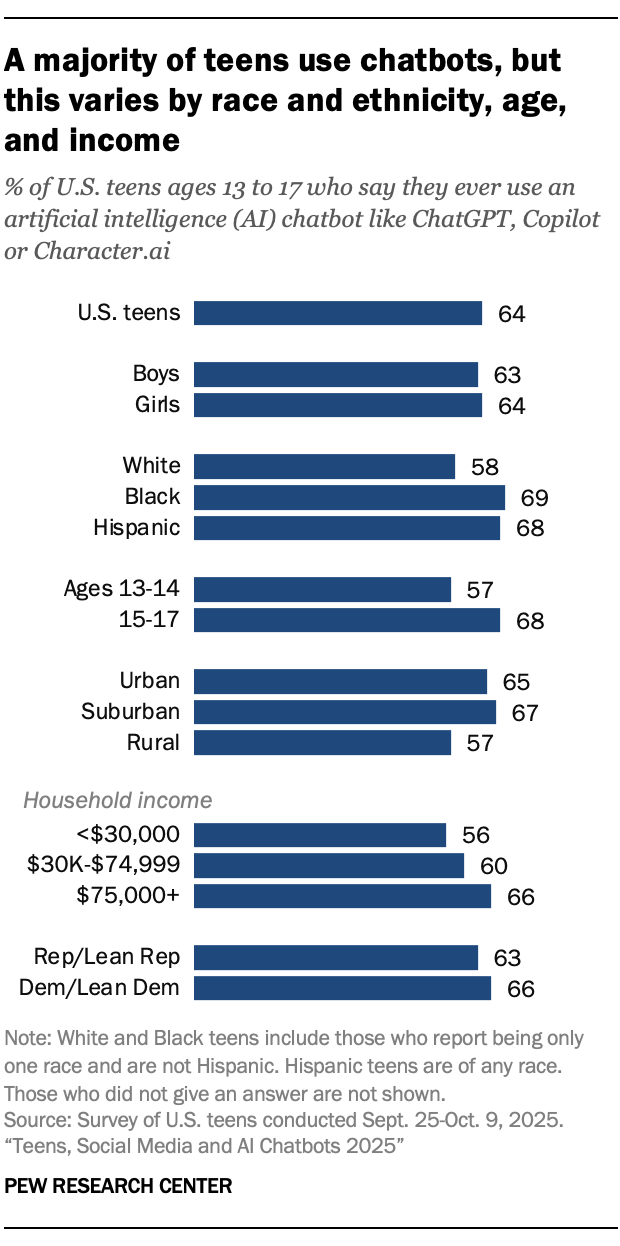
We instinctively know that the teenage years are critical in shaping identity. A neuroscience study from 2019 highlights the complexity of inputs that factor into a teenager’s development of identity. The study highlights that teens are often thought to make choices adults consider risky or confused due to the fact that their brains are still developing. That’s true, but as they explore who they are—academically, socially, artistically, morally—their emerging identity becomes a source of motivation. They start making choices that feel meaningful to them, not just choices based on impulse or peer pressure.
The parts of the self that matter most to a teen (for example: being an athlete, or a musician, a leader or, a good friend) can be encouraged, strengthened, or reframed.
The question is, who—or what—is framing and reframing it?
Hey teen Simba, remember you who you are
If you remember the original Lion King film, there’s a powerful scene where Simba’s father speaks to him in a dream and powerfully admonishes the little lion to “Remember who you are!” (Can’t you just hear the booming baritone of James Earl Jones’ voice bringing those lines to life?)
But what will kids remember when it’s not the Father telling them who they are, but a LLM scouring all the information in the world and hacking together some answers? If identity is itself shaped by the things that matter most to people and every day they are consulting AI for validation, companionship, and answers, the source material of that consultation is of critical importance.
Is AI just a modern Dr. Frankenstein piecing together new, frightening creatures?
The red flags of using AI for factual information are already waving, can you hear them flapping in the wind? When we add to this the deep, basic questions of meaning that humanity has always asked, questions answered by our great philosophers, teachers, and scribes, we should be especially on guard.
A recent article from Carnegie helpfully walks through the biases inherent in generative AI. The writer asked a series of questions of different AI platforms about geopolitical issues, human rights, and universal human values. He noticed that:
The LLMs can be said to have their own worldviews as they interpret global events. For instance, based on their responses, ChatGPT and Qwen were more closely aligned with liberal internationalism. Llama’s outlook was colored by a perspective centered on a muscular U.S. foreign policy, representing the realist school of international relations, while Mistral displayed a combination of liberalism and constructivism with a European tint. Finally, Doubao’s worldview was clearly based on Chinese nationalism.2
The author calls out the need for caution as humanity is being shaped intellectually by biased platforms, junk info, and politically saturated intel. AI is transforming how we acquire knowledge and interpret facts, which has direct impact on the nation state, which raises very real ethical concerns.
How much more careful do we need to be about how AI can shape us spiritually?
Take me back to that beach
I long to travel back in time to that beach on the shorelines of the Jordan. To hear the booming, thunderous voice of God, to see the Spirit fall like a dove, to see Jesus with the waters of baptism dripping from his face. To touch that spiritual grass and experience something real, substantive, essential.
What a gift we have that moment in scripture. It’s even better than the scene in the Lion King. It reminds all of us that we can know who we are, and that God can tell us so.
While we’re interacting with popular, important and critical AI technology every day in ways that are shaping our world let’s be sure to use the tool as a tool.
Hammer. Nail. Plumb line.
As for companionship, guidance, the spiritual insights and advice, how about we stick to scripture, and nurture young hearts and minds with the everlasting words of the Father.
More posts like it:

Read this article that features research by Common Sense in a 2025 study.
The World According to Generative Artificial Intelligence, Sinan Ülgen, Jan 27, 2025 retreived Mar 12, 2026 from Carnegie Endowment for International Peace
Sounds like something out of a science fiction novel - but alarmingly true. Machines giving advice and being adhered to vs the Word of God - Maranatha
Potent and critical post for the times we live in. Thank you for this